
What Is Granular Synthesis?
Imagine taking a single piano note and breaking it into hundreds of microscopic fragments. Each fragment can be repeated, stretched, transposed, reversed, or layered with others. The result might sound nothing like the original instrument: a shimmering atmosphere, an evolving drone, a rhythmic texture, or an entirely unfamiliar sonic landscape.
This is the fundamental principle behind granular synthesis.
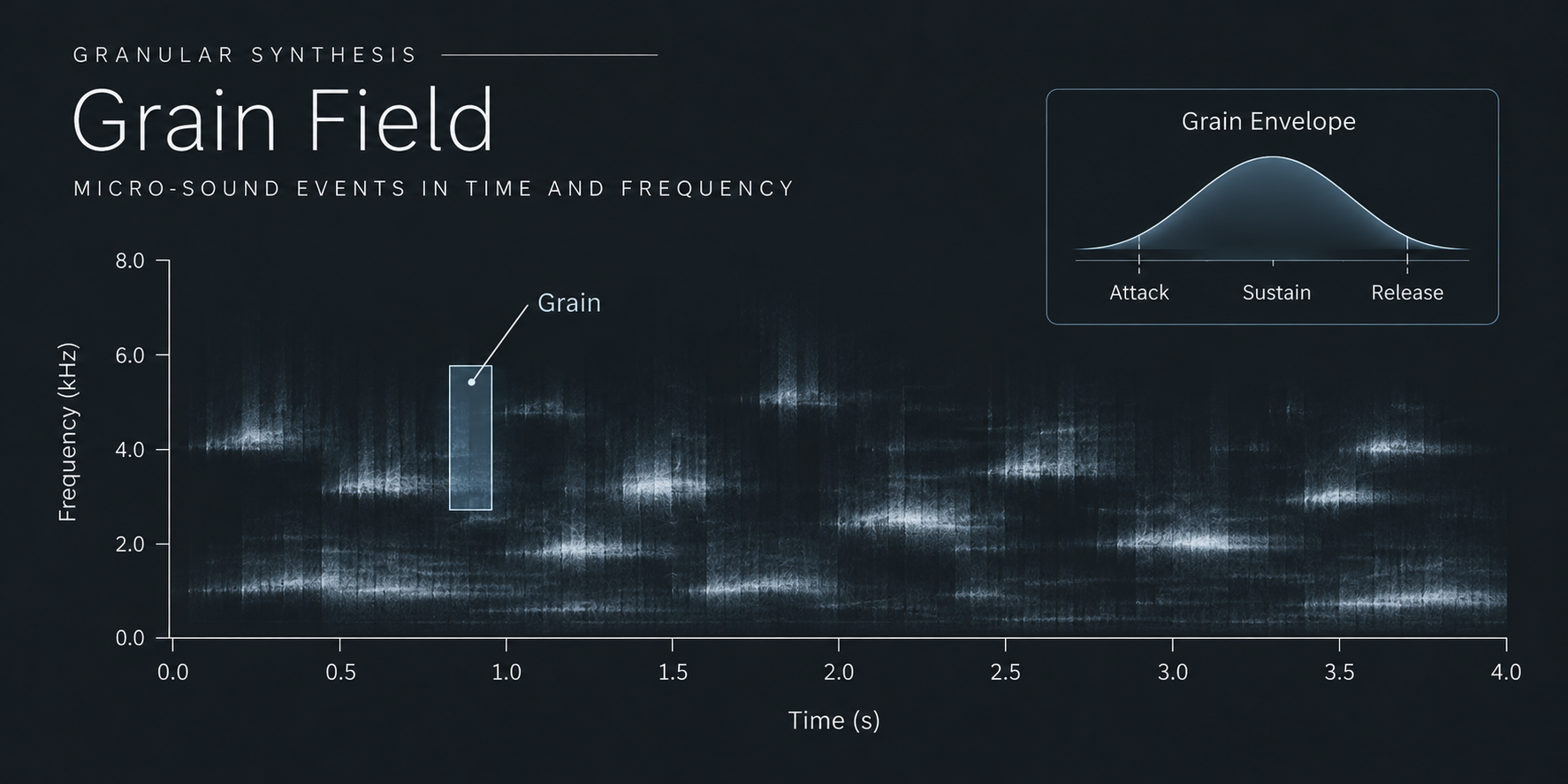
Unlike conventional synthesis techniques that construct sounds using oscillators, filters, and envelopes, granular synthesis operates at a microscopic timescale. Sound is generated or reconstructed from tiny acoustic events called grains, typically lasting between 10 and 50 milliseconds.[4]
When hundreds or thousands of these grains overlap, the human auditory system may perceive them as a continuous sound rather than individual events.
The real power of granular synthesis lies in its ability to manipulate not only the characteristics of sound but also its internal structure in time.
To understand how this remarkable technology emerged, we need to travel back several decades — long before digital audio workstations, software synthesizers, and modern computers existed.
The Scientific Origins: Dennis Gabor and Acoustic Quanta
The theoretical foundations of granular synthesis can be traced to the 1940s and the work of Hungarian-British physicist Dennis Gabor.
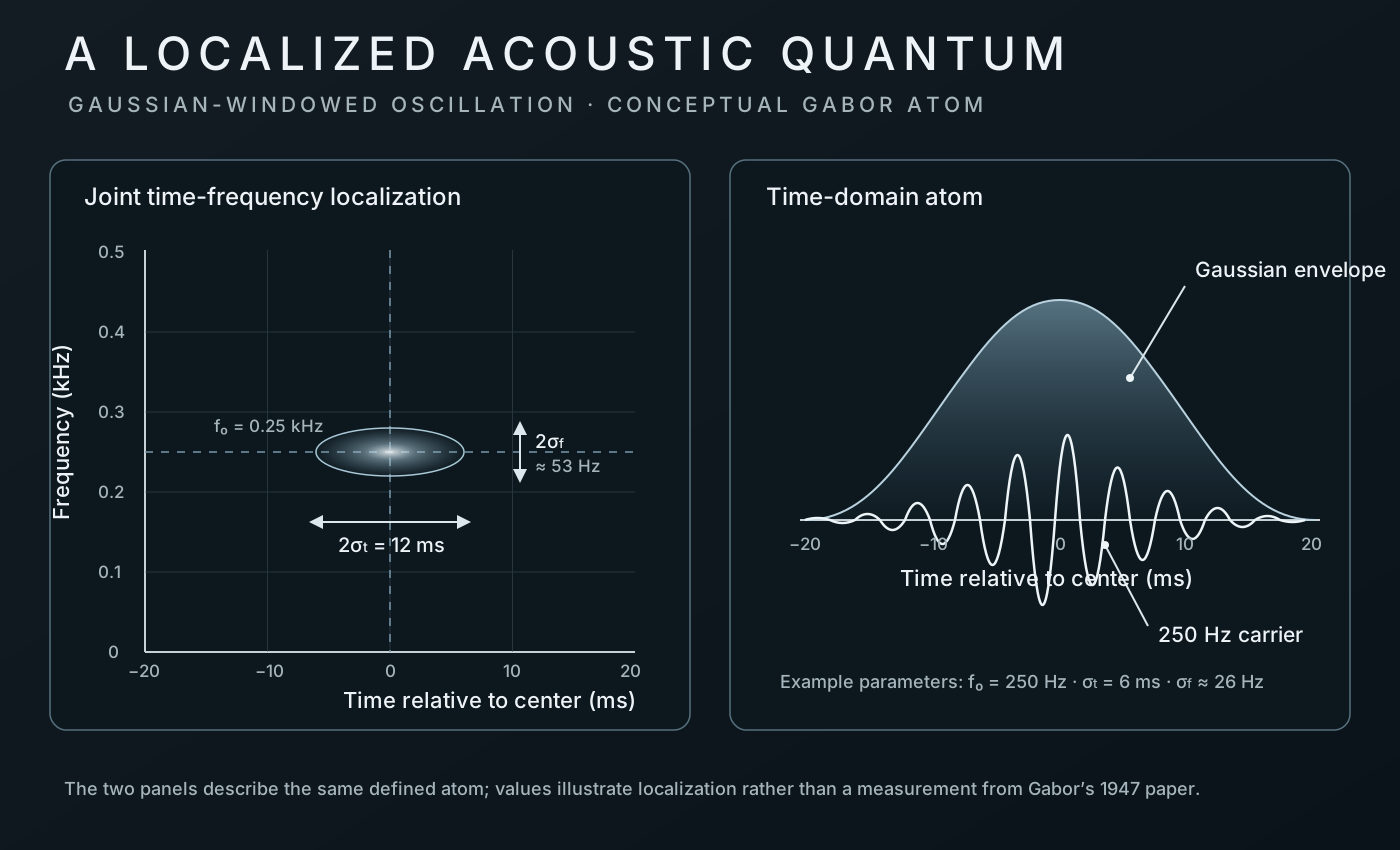
In his 1946 paper Theory of Communication and his influential 1947 publication Acoustical Quanta and the Theory of Hearing, Gabor investigated how complex signals could be represented through elementary units localized in both time and frequency.[2][1]
Traditional Fourier analysis describes signals in terms of sinusoidal frequency components. Although mathematically powerful, a conventional Fourier spectrum does not directly describe when individual events occur.
Gabor proposed a different perspective: sound could be analyzed using short, localized oscillatory events.
He called these elementary units acoustic quanta.
His research also explored a fundamental relationship between time and frequency resolution. A signal cannot be localized with arbitrary precision in both domains simultaneously. Improving temporal resolution necessarily affects frequency resolution, and vice versa.
This principle became essential to modern time-frequency analysis and digital signal processing.
Gabor was not developing a musical instrument. His research focused on communication theory, acoustics, and human hearing.
Nevertheless, his ideas provided the scientific foundation for a completely new approach to creating and organizing sound.
Iannis Xenakis: Turning Mathematical Theory into Music
The transformation of acoustic quanta into a compositional technique began with Iannis Xenakis, the Greek-French composer, architect, and mathematical thinker.[3]
During the 1950s, Xenakis became increasingly interested in the behavior of large collections of sound events.
Rather than composing exclusively with individual notes, melodies, and harmonies, he explored how thousands of small acoustic particles could form complex sonic masses.
Natural phenomena provided important conceptual inspiration: rainfall, insect swarms, turbulent winds, and other events consisting of countless individual components.
In 1959, Xenakis created Analogique B, an electronic tape composition that became part of Analogique A et B.
The work used short electronic sound particles, approximately 40 milliseconds long, organized according to mathematical and statistical principles.
These particles were assembled using the demanding tape-based production techniques available at the time.
Another important work was Concret PH (1958), constructed from recordings of burning charcoal. By cutting, layering, and rearranging recorded material, Xenakis produced a dense, crackling sound texture.
Although this was not digital granular synthesis in the modern sense, it demonstrated a closely related approach to microscopic sound organization.
Xenakis introduced a revolutionary compositional idea: the smallest components of sound could become the building blocks of musical form itself.

Curtis Roads and the Birth of Digital Granular Synthesis
The next major breakthrough arrived in the 1970s through American composer and computer music researcher Curtis Roads.
Inspired by Xenakis, Roads began exploring computer-generated granular synthesis at the University of California, San Diego, in 1974.[5]
His early experiments used the MUSIC V computer music system to generate large collections of short acoustic events.
At the time, computing power was extremely limited. Producing even a short passage of granular audio could require substantial processing time.
These early systems operated primarily through offline synthesis: composers programmed the desired parameters and waited for the computer to calculate the resulting sound.
Roads developed increasingly sophisticated methods for organizing grains into what became known as sound clouds.
His composition Prototype (1975) became an important example of early computer-generated granular music.
In subsequent decades, Roads continued developing granular techniques and contributed significantly to the theoretical understanding of microsound.
His 2002 book Microsound remains a major reference for composers, researchers, and sound designers interested in granular synthesis and microscopic sound structures.[4]

Barry Truax and the Real-Time Revolution
A significant milestone occurred in 1986 when Canadian composer Barry Truax, working at Simon Fraser University, developed an influential real-time granular synthesis system.[6][7]
Using specialized digital signal processing hardware, Truax could generate and manipulate dense streams of grains interactively.
His composition Riverrun (1986) demonstrated the expressive possibilities of this approach.
Instead of waiting for lengthy offline calculations, composers could modify parameters while the sound was being produced.
Grain duration, density, frequency, and temporal organization became immediate compositional controls.
Earlier real-time experiments had also existed, but Truax’s implementation became particularly influential through its integration into an interactive compositional environment.
The transition toward real-time processing fundamentally changed the practical potential of granular synthesis.
It was no longer exclusively a laboratory technique. It was becoming an expressive musical instrument.
How Does Granular Synthesis Actually Work?
At its core, granular synthesis involves generating, manipulating, and combining short sound events.[8]
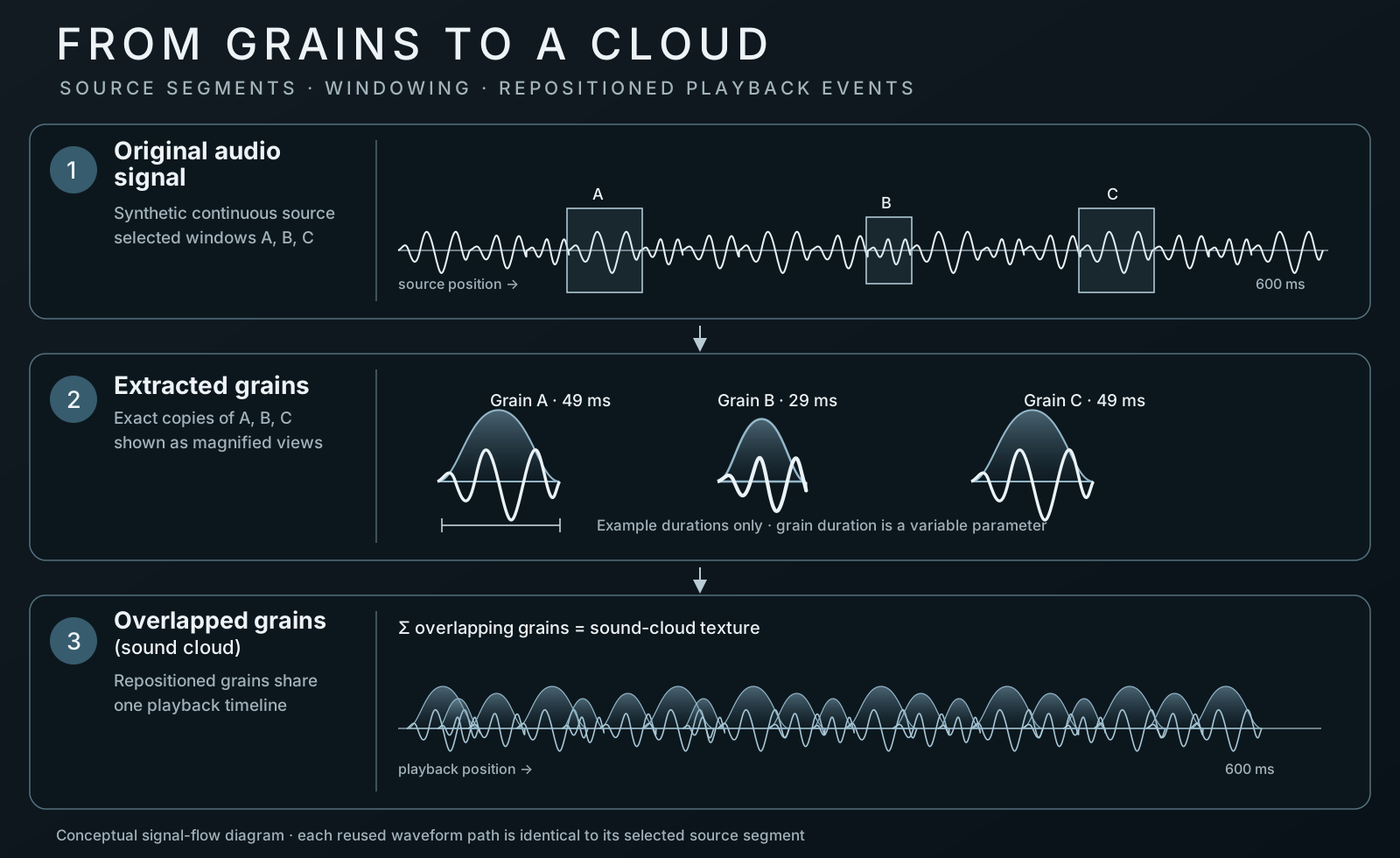
A grain may originate from a recorded audio sample, a synthesized waveform, or another signal source.
Each grain is controlled by several parameters:
- Grain Size
- Determines the duration of an individual grain.
- Density
- Controls how many grains are generated within a given period.
- Position
- Defines where a grain is extracted from the source material.
- Pitch
- Changes the perceived frequency or playback rate of individual grains.
- Envelope
- Shapes the amplitude of each grain to control its onset and decay.
- Spread
- Introduces variation in pitch, position, timing, or stereo placement.
One particularly important element is the grain envelope.
Without appropriate amplitude shaping, abrupt transitions between fragments may produce unwanted clicks.
Window functions, such as the Hann window, help smooth these transitions and allow grains to overlap more naturally.
The interaction between grain size, density, and overlap determines much of the resulting texture.
Short grains with irregular timing may create noisy, fragmented sounds. Longer overlapping grains can produce smooth, atmospheric textures.
Two broad approaches are commonly distinguished.
Synchronous granular synthesis generates grains at regular intervals, often producing periodic structures or recognizable pitches.
Asynchronous granular synthesis distributes grains irregularly, frequently using random or probabilistic processes. This can create complex, organic sound clouds.
Granular Synthesis and Time-Stretching
One of the most practical applications of granular processing is time-stretching.
Normally, slowing down an audio recording also lowers its pitch.
Granular techniques can separate these processes by repeatedly playing short portions of the recording while changing how quickly the playback position moves through the original material.
This allows sounds to be extended without necessarily changing their perceived pitch.
A short vocal phrase can become a sustained atmospheric texture. A piano note can evolve into a long, shimmering drone.
However, not all modern time-stretching algorithms use granular synthesis. Phase vocoders, transient-preserving algorithms, and hybrid methods are also widely employed.
Granular time-stretching can introduce distinctive artifacts, including rhythmic smearing, fluttering, or unusual tonal textures.
In experimental music production, these artifacts are often desirable rather than problematic.
What Sounds Can Granular Synthesis Create?
The creative possibilities extend far beyond conventional synthesizer sounds.
Ambient Pads and Drones
Short recordings can become evolving atmospheric layers. A single guitar note, vocal fragment, or field recording may transform into a sustained soundscape.
Glitch and Experimental Textures
Rapid changes in grain position, density, and pitch can produce fragmented rhythms, digital glitches, and unpredictable sonic events.
Cinematic Sound Design
Granular techniques are especially effective for creating mysterious atmospheres, science-fiction effects, abstract transitions, and unsettling environmental sounds.
Rhythmic Sound Manipulation
Regular grain triggering can generate pulsing textures, unusual percussion, and complex rhythmic structures.
Acoustic Instrument Transformation
A familiar acoustic recording can retain traces of its original character while being transformed into something entirely different.
This ability to move between recognizable sound sources and abstract sonic structures is one of granular synthesis’s defining creative strengths.
From Research Laboratories to Modern Music Production
Today, granular synthesis is widely accessible through software instruments, audio effects, and digital audio workstations.
Programming environments such as Csound, Max, and SuperCollider provide detailed control over granular processes.
Commercial and independent plugins offer more immediate workflows, allowing musicians to manipulate grain parameters through graphical interfaces and real-time modulation.
Modern implementations may include waveform displays, modulation systems, stereo positioning, synchronized grain triggering, and advanced sample manipulation.
An especially interesting development is the combination of granular and spectral processing.
Granular synthesis primarily reorganizes sound through small events in time. Spectral processing, by contrast, analyzes or transforms the frequency content of a signal.
Combining these approaches allows producers to explore both the temporal and frequency-domain characteristics of audio material.
For musicians interested in this creative territory, Spectra Gran by X-Audio combines granular sound manipulation with spectral processing techniques, offering a creative environment for transforming audio into evolving clouds, frozen textures, and experimental soundscapes.

Which Music Genres Use Granular Synthesis?
Granular synthesis originated in experimental electroacoustic composition, but its influence now extends across numerous musical styles.
In ambient and drone music, it produces slowly evolving textures and immersive atmospheric environments.
In IDM, glitch, and experimental electronica, granular techniques enable intricate rhythmic fragmentation and unconventional sample manipulation.
In techno and electronic dance music, producers use granular processing for atmospheric transitions, evolving effects, and unusual rhythmic elements.
In film scoring and video game audio, granular techniques can create supernatural environments, science-fiction textures, and sounds that would be difficult to achieve through conventional recording or synthesis.
The technology is not defined by any particular musical genre.
Instead, it offers a fundamentally different way of thinking about recorded and synthesized sound.
The Future of Granular Synthesis
Granular synthesis continues to evolve through improvements in computing power, modulation systems, and digital signal processing.
Modern techniques increasingly combine granular processing with spectral transformation, algorithmic composition, and advanced modulation.
Machine learning may also contribute to future workflows by helping analyze audio material, classify sound characteristics, or select suitable grain regions.
However, granular synthesis itself does not depend on artificial intelligence. Its core principles remain rooted in established acoustic and mathematical concepts.
Its enduring value lies in giving composers and producers direct access to the microscopic structure of sound.
Conclusion: A Different Way of Thinking About Sound
Granular synthesis has fundamentally expanded the possibilities of electronic music and sound design.
From Dennis Gabor’s acoustic quanta to Iannis Xenakis’ experimental compositions, Curtis Roads’ digital research, and Barry Truax’s real-time implementations, its history connects scientific discovery with musical innovation.
What once required specialized laboratories and extensive computation can now be explored within a modern music production environment.
The central concept remains remarkably powerful: sound is not simply a fixed recording or a single musical note.
It is a structure that can be divided, reorganized, transformed, and reconstructed.
From a single sound, entirely new sonic worlds can emerge.