
In a modern digital audio workstation, creating music can appear almost effortless. A musician draws a few notes into a piano roll, changes their velocity, moves a chord to another key, and sends the result to a synthesizer. Within seconds, an entirely new musical idea can emerge.
Behind these familiar actions lies one of the most influential technical developments in electronic music: the Musical Instrument Digital Interface, better known as MIDI.
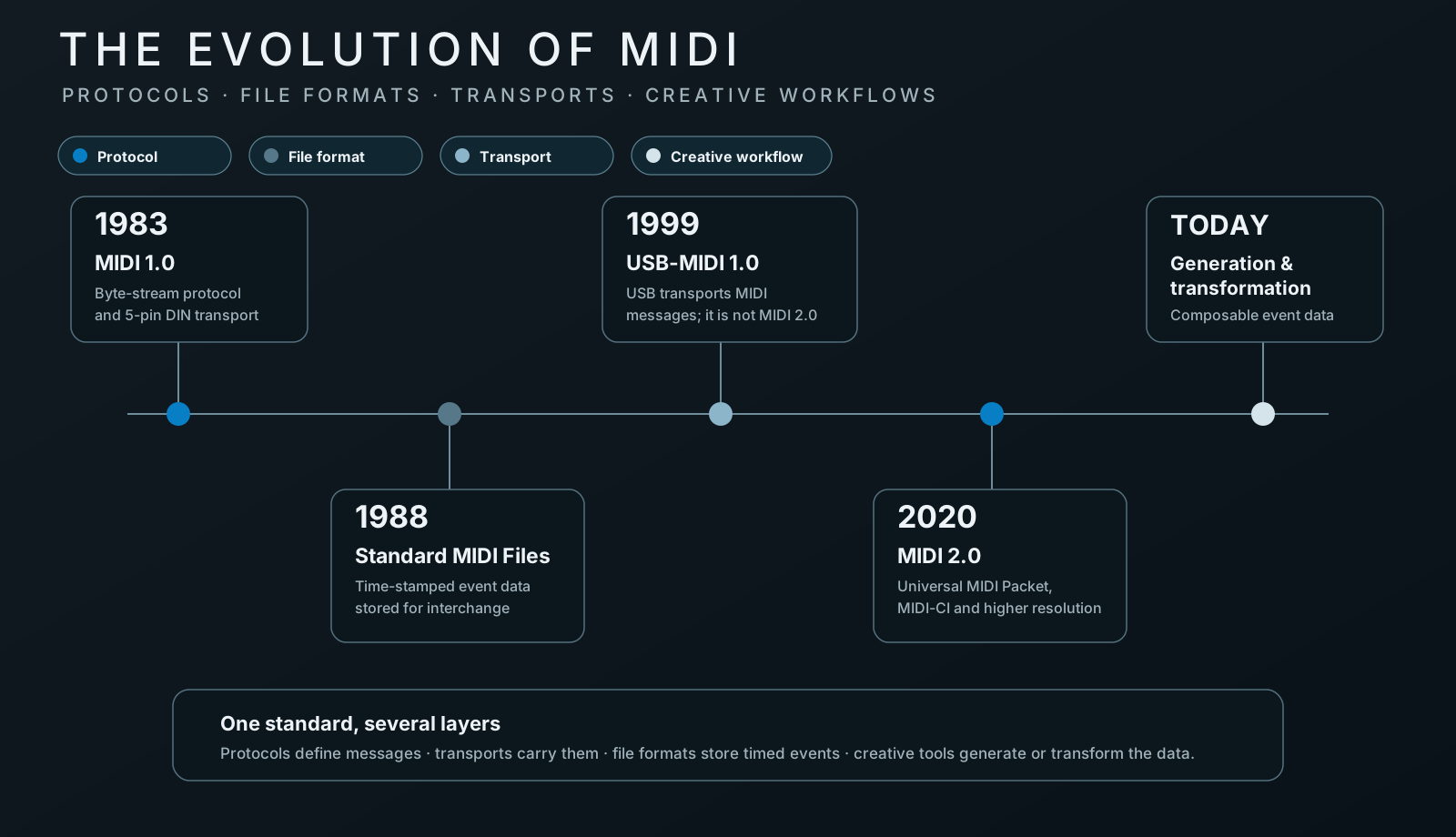
Introduced in 1983, MIDI established a common language through which electronic instruments could communicate. More than four decades later, that language remains fundamental to synthesizers, sequencers, digital audio workstations, and increasingly sophisticated systems for generating and transforming musical material.[1]
Yet MIDI was never designed to transmit sound. Its purpose was something more abstract—and arguably more powerful: to describe musical actions as digital information.
Understanding that distinction is essential to understanding the history of computer-based music production.
1. Before MIDI: When Instruments Could Not Speak the Same Language
Electronic instruments existed long before MIDI. Analog synthesizers, modular systems, electronic organs, and early sequencers already allowed musicians to control pitch, timing, and timbre through electrical signals.
The problem was compatibility.
A synthesizer might use control voltage to determine pitch and a gate signal to trigger a note. Another instrument might use different voltage conventions, trigger polarities, or proprietary digital connections.
Manufacturers developed their own systems, often designed primarily for their own products.
Connecting instruments from different companies could require special interfaces, modifications, or considerable technical knowledge.
As microprocessors became more common in musical instruments during the late 1970s and early 1980s, a new possibility emerged: musical performance could be represented as structured digital events rather than only as continuously varying electrical signals.
The challenge was establishing a shared language.
2. 1981–1983: The Birth of MIDI
The development of MIDI was a collaborative international effort rather than the invention of a single individual.
Important figures included Ikutaro Kakehashi of Roland, Dave Smith and Chet Wood of Sequential Circuits, Tom Oberheim, and engineers from several Japanese and American manufacturers.
In 1981, Dave Smith and Chet Wood presented a proposal for a Universal Synthesizer Interface at the Audio Engineering Society convention.[1]

The idea was to define a practical, relatively inexpensive communication system that manufacturers could implement across different instruments.
Subsequent discussions involving Roland, Sequential Circuits, Yamaha, Korg, Kawai, and others refined the proposed architecture.
In January 1983, a landmark public demonstration took place at the Winter NAMM Show in Anaheim, California.
A Sequential Circuits Prophet-600 communicated with a Roland Jupiter-6.

Two synthesizers from competing manufacturers were exchanging musical control information through a common digital interface.
The demonstration helped establish the practical viability of MIDI, and the MIDI 1.0 specification followed in 1983.[2]
What began as an interface for synthesizers would become a foundation for modern electronic music production.
3. What Is a MIDI Note?
A MIDI note is not a recording of a sound.
It is a representation of a musical event.
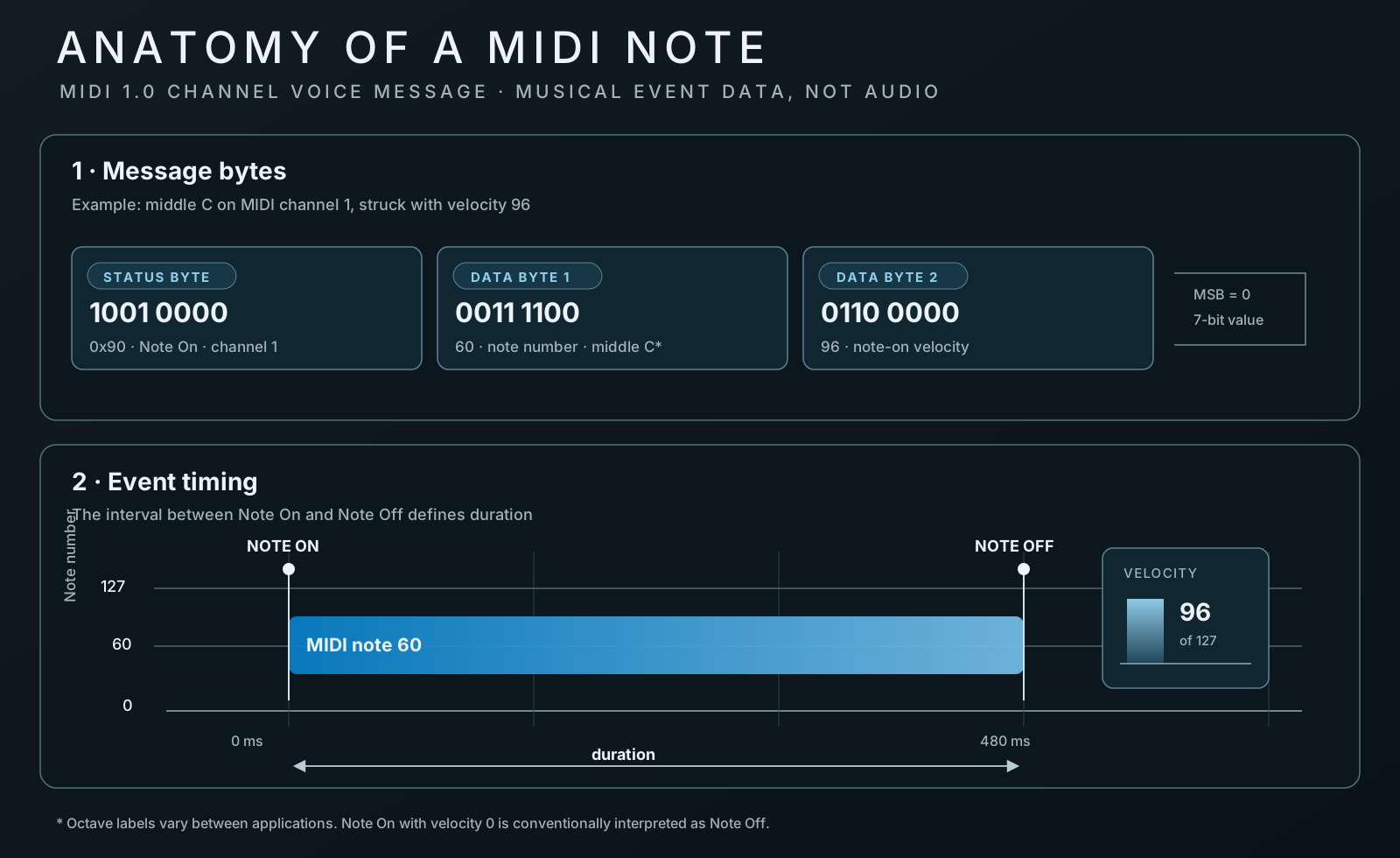
In MIDI 1.0, a Note On message typically communicates three important pieces of information:
- The MIDI channel.
- The note number.
- The velocity value.
A subsequent Note Off message indicates that the note should be released.
For example, MIDI note number 60 is conventionally associated with middle C, often labeled C4, although octave naming differs between software applications.
The note number identifies a pitch position within a 128-note range, from 0 to 127.
Velocity is represented by a seven-bit value. For a conventional Note On event, values from 1 to 127 indicate note activation, while velocity zero is commonly interpreted as Note Off.[3]
Velocity is frequently mapped to loudness, but it does not inherently specify audio amplitude. A synthesizer may instead use velocity to control filter cutoff, sample selection, modulation depth, or another expressive parameter.
This separation between musical instruction and sound generation is one of MIDI’s defining strengths.
The same MIDI sequence can control a piano, an analog synthesizer, a sampler, or a virtual instrument, producing radically different sonic results without changing the underlying notes.
4. The Technical Architecture of MIDI 1.0
The original hardware interface used five-pin DIN connectors and serial data transmission at 31,250 bits per second.
MIDI 1.0 messages distinguish status bytes from data bytes.
A status byte identifies the type of event, while subsequent data bytes carry values such as pitch or velocity.
The most significant bit of each data byte is zero, leaving seven bits for its value.
This explains why so many MIDI parameters use the familiar numerical range of 0–127.
A single MIDI 1.0 connection supports 16 logical channels, allowing different instruments or parts to be addressed independently.
In addition to note messages, MIDI supports pitch bend, control changes, program changes, channel pressure, timing messages, and other forms of control.[4]
These capabilities made it possible to coordinate increasingly complex electronic music systems.
However, the original architecture also had limitations. Serial transmission could become congested when many messages were sent together, and some controls had relatively coarse resolution.
Later extensions and higher-resolution message combinations addressed certain limitations, but the underlying architecture remained recognizable.

5. From Hardware Sequencers to the Computer Piano Roll
MIDI changed more than instrument connectivity.
It changed how musical performances could be recorded and edited.
Instead of recording an audio waveform, a sequencer could store the timing and content of individual MIDI events.
A recorded performance could therefore be modified after the fact.
Notes could be moved, shortened, lengthened, transposed, or assigned to different instruments.
The Standard MIDI File format, adopted in 1988, further enabled the exchange of sequence information between software applications.[5]
It provided a structured way to store MIDI events together with timing information and other musical metadata.
As personal computers became central to music production, MIDI sequencing evolved into graphical editing environments.
One of the most enduring interfaces was the piano roll.
In a piano-roll editor, pitch is represented vertically and musical time horizontally. Notes appear as rectangular objects whose position and length describe their musical placement.
The concept is closely related to the perforated paper rolls used in mechanical player pianos, although modern digital sequencers provide far greater flexibility.
The piano roll made musical information directly editable.
Composition was no longer limited to performing notes in real time. It could also involve constructing, rearranging, and transforming musical structures visually.

6. USB-MIDI: A New Connection for Computer Music
The original five-pin DIN connection was well suited to hardware instruments, but the growth of computer-based music production created demand for a more convenient transport.
USB offered a practical solution.
The USB-MIDI 1.0 device-class specification was adopted in 1999.[6]
It defined how MIDI data could be transported over Universal Serial Bus connections.
This was an important distinction: USB-MIDI did not replace MIDI’s musical meaning. It changed how MIDI messages traveled between devices.
Instead of relying exclusively on dedicated DIN interfaces, compatible keyboards, controllers, and synthesizers could communicate directly with computers over USB.
USB also enabled multiple virtual MIDI ports over a single physical connection.
For musicians, the benefits were substantial: simpler cabling, broader computer integration, and increasingly convenient plug-and-play workflows.
However, a USB connector does not automatically mean that an instrument uses MIDI 2.0.
Many modern USB keyboards and controllers still communicate using MIDI 1.0 messages.
The physical transport and the MIDI protocol version are separate concepts.
7. MIDI 2.0: A Major Technical Evolution
After decades of remarkable stability, MIDI underwent its most significant architectural expansion.
The core MIDI 2.0 specifications were adopted in 2020, with important updates following in 2023.[7]
MIDI 2.0 was designed to extend MIDI 1.0 rather than simply replace it.
Its innovations include bidirectional communication, capability negotiation, more expressive note control, and substantially increased parameter resolution.
The Universal MIDI Packet, or UMP, provides a structured packet-based representation for MIDI information.
MIDI 2.0 Channel Voice messages can use higher-resolution values, including 16-bit velocity and 32-bit controller data for relevant message types.
The protocol also introduces enhanced per-note expression, allowing individual notes to receive more detailed control.
This is particularly valuable for expressive electronic instruments and sophisticated performance systems.
MIDI Capability Inquiry, or MIDI-CI, provides mechanisms through which devices can discover and negotiate supported capabilities.
These developments address limitations that musicians and instrument designers had encountered for decades.
Why Has MIDI 2.0 Adoption Been Gradual?
The answer is partly the success of MIDI 1.0 itself.
MIDI 1.0 remains sufficient for a remarkable range of everyday musical tasks.
Most producers can write melodies, build chord progressions, control synthesizers, and automate parameters without requiring the additional resolution of MIDI 2.0.
Furthermore, the benefits of a new communication protocol depend on support throughout the signal chain.
A controller, operating system, digital audio workstation, plugin, and external instrument may all need compatible implementations before the full capabilities become available.
There has nevertheless been substantial progress.
Apple introduced operating-system-level MIDI 2.0 support in 2021, Android added support in 2022, and Microsoft announced the general availability rollout of Windows MIDI Services with MIDI 2.0 support in February 2026.[8][9][10]
MIDI 2.0 is therefore neither abandoned nor universally adopted.
It represents a continuing transition in which mature MIDI 1.0 workflows coexist with a more expressive technical architecture.
8. MIDI as Musical Data: Beyond Recording Performances
The development of MIDI also created a foundation for algorithmic composition.
Once pitch, duration, velocity, and timing can be represented as data, they can be generated or transformed according to rules.
A program can construct a scale, choose notes from a harmonic structure, produce rhythmic variations, or distribute events according to probability.
These techniques belong to a broader tradition of computational music that includes rule-based composition, stochastic processes, generative systems, and interactive performance.[11]
A simple example is scale-constrained note generation.
Suppose a musical system is configured to use the notes of A natural minor:
A – B – C – D – E – F – G
An algorithm can select notes from this collection while controlling register, rhythm, and note density.
A more advanced system might incorporate chord tones, melodic contour, rhythmic relationships, voice leading, and controlled variation.
The result is not necessarily random music.
It can be structured musical material created through explicit compositional constraints.
9. From MIDI Editing to Intelligent MIDI Generation
Traditional MIDI sequencing begins with a performance or a manually entered sequence.
Generative MIDI systems can begin instead with musical parameters.
A producer may define a key, scale, rhythmic framework, or harmonic direction and allow a system to generate candidate phrases.
Several techniques are particularly relevant.
Scale awareness ensures that generated notes belong to a selected pitch collection, although scale membership alone does not guarantee musical coherence.
Rhythmic constraints organize events around pulses, subdivisions, accents, and phrase structures.
Probability introduces variation without requiring every note to be predetermined.
Seed-based generation makes it possible to derive repeatable patterns from an initial state, provided the algorithm and its relevant parameters remain unchanged.
Controlled evolution transforms existing musical material while preserving selected characteristics.
The challenge is balancing predictability with variation.
A system that repeats every event becomes static. A system that changes everything without musical constraints may lose its sense of structure.
Effective generative tools allow the musician to determine how much stability, surprise, and harmonic organization is desirable.
10. Harmonic Seed Pro: A Contemporary Application
Modern MIDI tools demonstrate how the principles established in the early 1980s continue to support new approaches to composition.
X-Audio’s Harmonic Seed Pro explores this territory through scale-aware MIDI generation, seed-based variation, controlled evolution, and synchronized musical patterns.
Its approach reflects an important distinction: a MIDI generator does not need to create audio to become a meaningful compositional instrument.
Instead, it creates musical instructions that can be interpreted by synthesizers and virtual instruments.
Generated MIDI can then become the starting point for further arrangement, sound design, and performance.
11. Transforming Existing MIDI: Shift Doktor
Not every creative MIDI process begins with generating new notes. Existing MIDI performances can also be transformed into new musical variations.
A melody, bassline, or chord sequence can be shifted across octaves, transposed by musical intervals, or modified according to a selected scale. These transformations allow musicians to explore new harmonic relationships while retaining aspects of the original performance.
X-Audio’s Shift Doktor, a Max for Live MIDI effect, takes this approach by transforming incoming MIDI notes through octave shifting, interval adjustments, scale-aware processing, and probability-based variations.
Rather than replacing the original musical idea, it provides ways to reinterpret and evolve existing MIDI material in real time.
Together, Harmonic Seed Pro and Shift Doktor illustrate two complementary approaches to contemporary MIDI composition: generating new musical structures and creatively transforming those that already exist.
12. The Future of MIDI
MIDI’s longevity is unusual in digital technology.
A communication standard introduced in 1983 continues to connect instruments and software in contemporary studios.
Its success is rooted in a relatively simple principle: musical information should remain independent of the device that produces the sound.
MIDI 2.0 expands this principle with greater expressive detail and more sophisticated communication between devices.
Meanwhile, algorithmic composition and generative music tools demonstrate that the value of MIDI extends beyond transmitting keyboard performances.
It is also a flexible representation of musical ideas.
From the first interconnected synthesizers to contemporary MIDI generation, the underlying achievement remains the same.
MIDI made musical actions portable, editable, and programmable.
And that continues to shape how electronic music is created.